
 Student Login



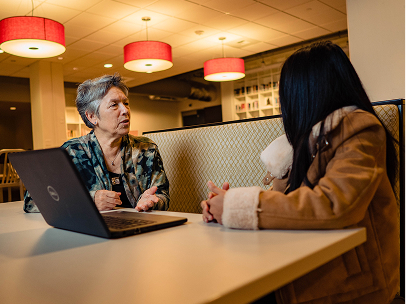




Today’s students have plenty of choices between online vs. in-person college, along with hybrid programming. Advances in modern technology mean the debate continues to grow over which is best, but ultimately, the decision is personal. The truth is that students can learn well in both formats, so the right choice depends on your own learning style and educational needs.
Quick Comparison: Online vs. In-Person College at a Glance
For some people, online school is better than in-person classes. They love the face-to-face engagement and hands-on opportunities. Others prefer online education for its flexibility and accessibility.
Here’s a quick comparison of the pros and cons of each option:
| Online Education | In-Person Learning | |
| Flexibility |
|
|
| Schedule control |
|
|
| Networking |
|
|
| Hands-on learning |
|
|
| Cost drivers |
|
|
A third option is to pursue a hybrid program that combines online and in-person elements. Read on to learn more about all your options.
FIND THE RIGHT PROGRAM FOR YOU
Online College: Pros and Cons
Whether you’re looking to finish your degree online, start a new program, or take stand-alone courses, online classes can be as effective as in-person classes. Before enrolling, take the time to analyze the benefits and drawbacks of distance learning and determine if it aligns with your goals.
Pro: Flexibility for Working Adults
Online learning is easier to schedule around work and family. There’s no commute, and there may be more options to take classes on your own schedule. Many students can advance their careers without leaving their current jobs.
FAQ: What do employers think about online degrees?
In a 2024 survey, 87.4% of employers reported hiring employees with online degrees. All of them reported no difference in pay between those with in-person versus online degrees.
Another global survey showed that 55% of employers value online degrees as much as in-person ones, especially in technology-related fields. U.S. employers have been slower to come around to online degrees, with Canadian employers being more accepting.
Pro: More Choice of Programs
With flexible online degree programs, you can study from anywhere. At City University of Seattle, we have students from across the United States and around the world.
Con: Technical Requirements
Online courses often require you to download and use unfamiliar software. If you’re less technically savvy, you’ll want to budget extra time for troubleshooting and talking with help desk services.
FAQ: How does online college work? (LMS, deadlines, live vs. async)
The structure of each class depends on the program. Some programs offer synchronous classes, which online students all attend live at a scheduled time. Others have asynchronous classes, which students can access at their convenience. Both types of classes have assignment and test due dates.
Students typically complete assignments via interactive learning platforms. CityU’s learning management system Brightspace engages students with a responsive interface and mobile apps to maximize online learning.
Con: More Self-Motivation
Are online classes as effective as in-person classes? As with any courses, it depends on how much you put into them. Online learning requires you to keep yourself on task, which can be challenging for some students.

In-Person College: Pros and Cons
Advocates of face-to-face learning tend to focus on networking and social interaction, but there are more benefits and drawbacks worth considering.
Pro: More Structure and Focus
Being in a classroom can mean fewer distractions than studying at home or even in a library. Everyone in the room is focused on the same thing, which can help you stay engaged.
Pro: Hands-On Training
Many courses require laboratory work or other skills practice that you can’t do or is less effective online. Studying in person gives you access to hands-on opportunities for learning.
Con: Fewer Program Options
If you study in person, you’re limited to courses in your area. Online study gives you more choice of programs.
Con: Learning Style Differences
Not all students thrive in a classroom setting. Online learning lets students customize their learning environment and study with less social pressure.
Hybrid Learning: The Best of Both Worlds
Still debating between online vs. in-person classes? Hybrid learning, also called blended learning, can give you many advantages of both options:
- Accommodation for work schedules: If your schedule is flexible enough to incorporate some in-person classes but a full on-campus schedule is logistically challenging, hybrid learning provides balance.
- Financial flexibility: You can go to schools that offer more aid for tuition and fees or meet your employer’s reimbursement requirements, without having to quit your job to be fully on campus.
- Lab work options: You can take a science course with a lab requirement on campus, while attending remotely for classes that require less hands-on work.
- Less commuting: If you live in the Puget Sound region, traveling to CityU as part of a hybrid program lets you benefit from face-to-face learning on your terms.
If you need flexible study options but enjoy face-to-face interaction, don’t stress over whether online university is better than in-person. Enroll in a hybrid program and experience both.
How To Choose What Works Best for You
Online vs. in-person college is a personal decision and deserves careful thought. Use this checklist to help you make your decision:
- Need others in the room to focus? Try in-person.
- Have a busy schedule or need to stay close to home? Study online for more flexibility.
- Still working on your technical skills? In-person can offer hands-on practice.
- Have lab requirements but prefer a limited commute? Hybrid lets you balance both.
In the end, the most important factor is how well a program fits your life. If you’re a busy working adult, look at schools with non-traditional student options, such as flex paths and ongoing career support.
Ready To Learn Your Way? CityU Makes It Possible
CityU believes in supporting students to pursue career advancement while maintaining a work-life balance and taking care of those who need them. We help you learn on your own terms, whether that means studying online, in-person, or hybrid.
Don’t let decision paralysis hold you back. Find your program today and take the next step in your career.